01 · Fundamentals
Start where you are, not where you think you should be
The best beginner workout is one you can repeat next week. Many people stop because they start too hard: a punishing first session leads to soreness, dread and a skipped second session. A beginner plan should feel achievable — even slightly too easy — for the first couple of weeks.
For context, the World Health Organization recommends that adults aim for 150–300 minutes of moderate aerobic activity per week (or 75–150 minutes of vigorous activity), plus muscle-strengthening activities on two or more days. That's a long-term target, not a day-one requirement. The WHO also notes that some physical activity is better than none.
A balanced week includes three ingredients: strength (working muscles against resistance), cardio (raising your heart rate for a sustained period) and mobility and recovery (moving comfortably and letting your body adapt). Our eight routines cover all three.
02 · Warm-up
How to warm up in five minutes
A warm-up gradually increases your heart rate, breathing and body temperature, and rehearses the movements you're about to do. It helps exercise feel smoother and gives you a moment to check in with how your body feels today.
A simple five-minute template
- Pulse raiser (2 minutes): march in place, step side to side or walk around the room.
- Joint circles (1 minute): shoulders, hips and ankles — slow, controlled circles in both directions.
- Movement rehearsal (2 minutes): easy versions of the session's main moves — half squats, wall push-ups, hip hinges.
Save long, static stretch holds for the cool-down. Before a workout, keep movements flowing and gentle.

03 · Cool-down
Cooling down: bring your body back to calm
A cool-down lets your heart rate and breathing settle gradually. It's also the best time for relaxed stretching, since your muscles are warm.
- Walk or march slowly for 1–2 minutes, letting your breathing return to normal.
- Hold 3–5 stretches for the areas you worked, about 20–45 seconds each.
- Stretch to mild tension, never pain, and don't bounce.
- Finish with a minute of slow breathing — in for four counts, out for six.
On rest days, the Gentle Recovery Stretch works as a stand-alone session.
04 · Technique
Proper exercise form, simply explained
Good form means moving in a way that is controlled, repeatable and comfortable for your body. You don't need a perfect textbook position — you need consistency and control.
Six cues that apply to almost every exercise
- Long spine: keep your head, ribs and pelvis stacked; avoid slumping or over-arching.
- Breathe: exhale on the effort (standing up, pushing away), inhale on the return. Avoid holding your breath.
- Control the tempo: roughly two seconds down, one to two seconds up. Momentum hides weakness.
- Knees follow toes: in squats and lunges, let your knees track in line with your middle toes.
- Pain-free range: work within a range that feels comfortable. Depth comes with practice.
- Quality over quantity: when form breaks down, the set is finished — even if you haven't hit the number.
The last rep should look like the first rep. If it doesn't, that's your signal to stop the set.
A phone video of yourself from the side is a surprisingly useful feedback tool. Compare it with the step-by-step instructions on each workout page.
05 · Bodyweight
Bodyweight training: the free, flexible foundation
Your body weight is plenty of resistance for a beginner. Bodyweight training teaches the fundamental movement patterns you'll use for the rest of your training life:
| Pattern | Beginner exercise | Everyday equivalent |
|---|---|---|
| Squat | Squat to chair | Getting up from a seat |
| Push | Incline or wall push-up | Pushing a door or getting up from the floor |
| Hinge | Glute bridge, hip hinge | Picking something up safely |
| Lunge | Supported reverse lunge | Climbing stairs |
| Core | Bird dog, plank | Carrying shopping steadily |
To make bodyweight exercises harder without equipment, slow the tempo, add a pause, increase reps, or change leverage (for example, moving push-ups from a counter to a lower step). Start with the Full-Body Bodyweight Starter.
06 · Cardio
Low-impact cardio that's kind to joints
Low-impact cardio keeps at least one foot on the floor, so there's no jumping. It's quieter, gentler on knees and ankles, and still raises your heart rate effectively.
How hard should it feel?
Use the talk test: at a moderate effort you can talk in short sentences but couldn't sing. On a 1–10 effort scale, beginners can aim for around 4–6.
- Start with 30-second work intervals and 30 seconds of easy marching.
- Wear supportive shoes and clear the floor.
- Brisk walking outdoors counts — and is one of the most accessible forms of cardio.
Try the Low-Impact Living Room Cardio routine.
07 · Mobility
Mobility and flexibility: move more comfortably
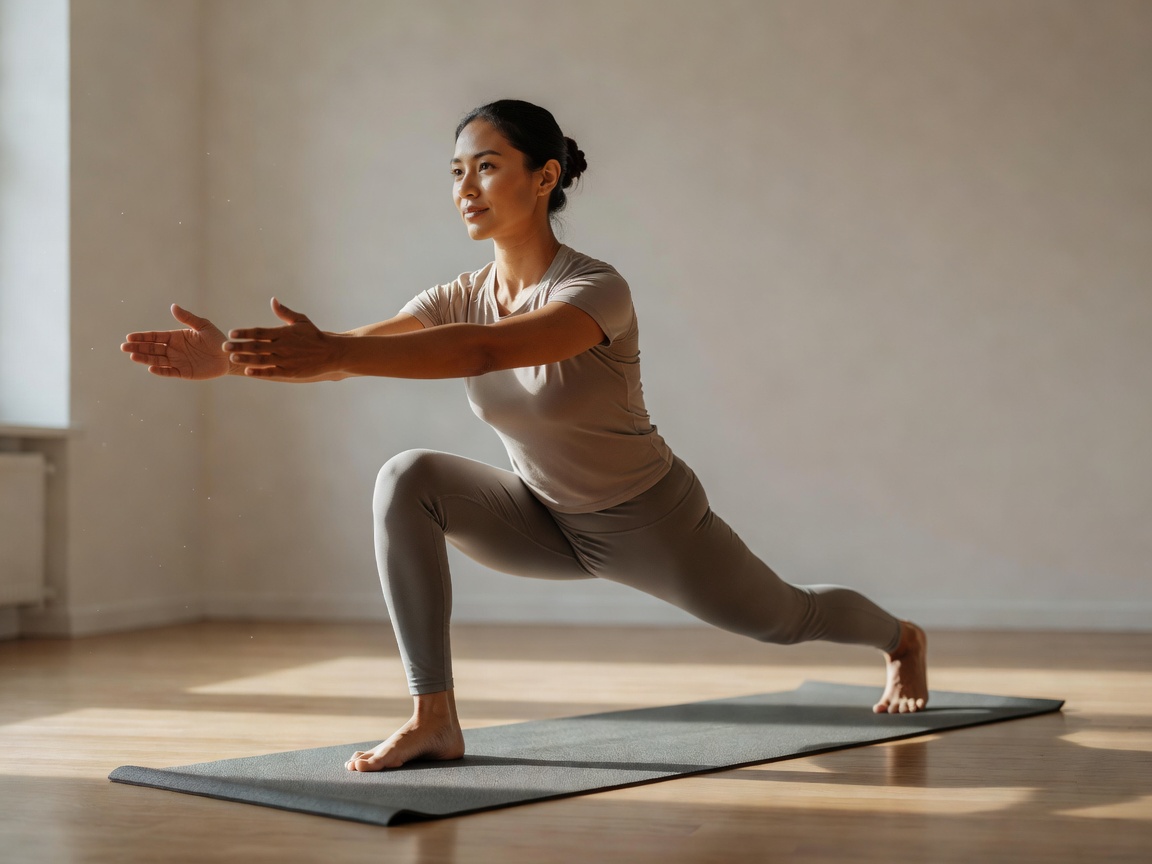
Flexibility is how far a muscle can lengthen; mobility is how well you can actively control movement through a joint's range. Beginners often benefit from both — particularly if they sit for long periods.
- Mobility drills (cat-cow, open books, ankle rocks) are slow, controlled and good before workouts or as a morning routine.
- Static stretches (held 20–45 seconds) suit cool-downs and rest days.
- Little and often works well: 10 minutes most days is more useful than an hour once a month.
See the Morning Mobility Flow.
08 · Modifications
Exercise modifications: every move has an easier version
Modifying an exercise isn't "cheating" — it's how you match the work to your current ability. Every exercise in our routines lists an easier option and a progression.
Common ways to make exercises easier
- Add support: hold a chair or wall for balance.
- Raise the surface: push-ups against a wall or counter instead of the floor.
- Reduce range: squat to a higher chair; lunge less deeply.
- Shorten levers: plank from knees; bend knees in leg movements.
- Slow down and rest more: longer rest periods are always allowed.
When to skip an exercise
Skip or swap an exercise if it causes joint pain, if you cannot control the movement even with the easier option, or if a health professional has advised you to avoid it. For example, swap lunges for sit-to-stands if your knees complain. If getting to the floor is difficult, the Chair & Wall Starter keeps everything upright.
09 · Scheduling
Building a realistic weekly workout schedule
The right schedule is the one that fits around your work, family and energy levels. Choose the template that matches the time you can genuinely commit — you can always add more later.
| Plan | Mon | Tue | Wed | Thu | Fri | Sat | Sun |
|---|---|---|---|---|---|---|---|
| 3 days ~70 min | Full-body | Rest / walk | Cardio | Rest | Band or full-body | Walk | Rest |
| 4 days ~95 min | Full-body | Cardio | Rest | Band strength | Core + mobility | Walk | Recovery stretch |
| Full week ~140 min | Full-body | Cardio | Mobility | Band strength | Core + walk | Cardio | Recovery stretch |
- Leave at least one day between strength sessions that work the same muscles.
- Anchor workouts to existing routines — after morning coffee, before dinner.
- Write sessions into your calendar like appointments.
- Plan a "minimum version" (e.g. one round) for low-energy days.
Track your week with the interactive weekly plan on our home page.
10 · Equipment
Choosing basic home workout equipment
You can start with nothing at all. If you'd like to add equipment over time, these items are versatile, compact and widely available. We don't sell or endorse specific products.
| Item | Why it helps | What to look for |
|---|---|---|
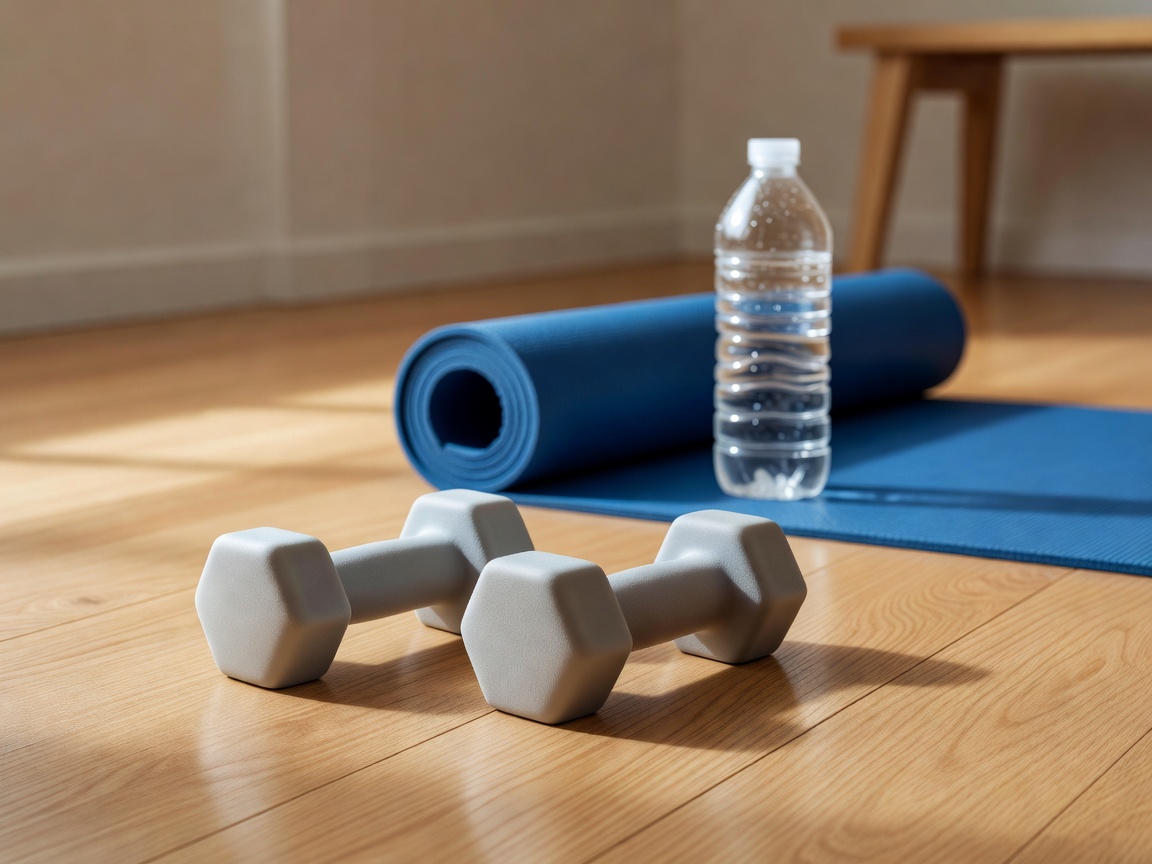
| Exercise mat | Cushioning and grip for floor work | Non-slip surface, comfortable thickness for your knees |
| Sturdy chair | Support for squats, balance and incline work | No wheels; place it against a wall |
| Resistance bands | Adjustable resistance in a tiny space | A set of light to medium tensions; check regularly for wear |
| Light dumbbells | Simple progression for strength exercises | A weight you can lift 10–12 times with control |
| Towel | Stretching aid and knee cushion | Any long, sturdy towel works |
Explore the Resistance Band Total Body and Beginner Dumbbell Strength routines.
11 · Recovery
Recovery and rest days: where progress happens
Training provides the stimulus; recovery is when your body adapts. Rest days aren't lost days — they're part of the plan.
- Sleep: consistent, sufficient sleep supports energy and recovery.
- Active recovery: gentle walking, mobility or stretching on rest days.
- Hydration and regular meals: support your energy for training.
Soreness vs pain
Mild muscle soreness 24–72 hours after a new activity is common for beginners and usually eases as your body adapts. Sharp, stabbing or joint pain, swelling, or pain that worsens during exercise is different — stop, rest, and seek qualified advice if it persists.
12 · Habits
Maintaining consistency when life gets busy
Consistency beats intensity. These strategies help workouts become a habit rather than a decision you have to make each day:
- Make it obvious: leave your mat or shoes out where you'll see them.
- Make it small: commit to just the warm-up. Often you'll continue.
- Stack it: attach exercise to an existing habit ("after I make tea, I'll do the mobility flow").
- Track it: ticking off a day is satisfying — use the weekly plan tracker.
- Never miss twice: missing one session is normal. Simply do the next one.
A ten-minute session you do is worth more than a perfect hour you skip.
13 · Progression
Progressing gradually and safely
Your body adapts to what you ask of it, so over time the same workout will feel easier. That's when to progress — gently.
- When you can complete all sets with good form for two sessions in a row, progress one variable.
- Options: add 1–2 reps, add a round, slow the tempo, reduce rest slightly, or try the next exercise variation.
- Increase total weekly training time gradually rather than in large jumps.
- Every few weeks, take an easier week if you feel run-down.
14 · Safety
Safety and when to stop
This guide provides general fitness education rather than individualised medical advice, diagnosis or treatment. Exercise within your abilities and increase intensity gradually.
Consider speaking to a doctor or qualified health professional before starting a new exercise programme if you have a heart, lung, metabolic or joint condition, are pregnant or recently postnatal, are recovering from injury or surgery, take medication that affects heart rate or balance, or have been inactive for a long time.